LLM4ED
A large language model proposes and revises candidate equations round by round, filtered by a sparse reward.
Usage
import kd
from kd import Llm4edConfig

dataset = kd.load_llm4ed_heat()
model = kd.Model(
    algorithm="llm4ed",
    generations=12,
    config=Llm4edConfig(base_url="https://api.openai.com/v1"),
)
model.fit(dataset)
Main parameters
| Parameter | Default | Resume | Description |
|---|---|---|---|
temperature |
0.8 |
resume-safe | LLM sampling temperature. |
max_tokens |
1024 |
resume-safe | Maximum decoded tokens per request. |
stop_threshold |
0.995 |
resume-safe | Reward threshold for completion. |
reward_limit |
0.5 |
resume-safe | Minimum admitted sparse reward. |
pool_size |
5 |
resume-safe | Elite-pool capacity. |
All fields of Llm4edConfig
| Field | Type | Default |
|---|---|---|
temperature |
float |
0.8 |
max_tokens |
int |
1024 |
stop_threshold |
float |
0.995 |
reward_limit |
float |
0.5 |
pool_size |
int |
5 |
init_num |
int |
20 |
samples_per_epoch |
int |
8 |
max_llm_calls_per_propose |
int |
50 |
max_llm_calls_per_run |
int |
200 |
seed |
int |
0 |
model |
str |
gpt-4o-mini |
base_url |
str \| None |
None |
tape_record_path |
str \| None |
None |
extra_body |
dict[str, Any] \| None |
None |
Search space
LLM4ED asks a language model for coefficient-free equations over a fixed symbol
library and fits their coefficients by sparse regression. It operates on one
scalar field with exactly one spatial axis and one time axis. The symbols are the
field u, derivatives u_x, u_xx, u_xxx, and spatial coordinate x.
The prompts specify +, -, *, /, squares and cubes; the parser also
accepts integer powers through five. Explicit spatial dependence is
expressible. Extra fields, other-axis derivatives, mixed space-time derivatives,
higher spatial derivatives, trigonometric functions, exponentials, square roots
and standalone constants are outside this route's symbol library.
Extra fields and other spatial axes are refused before proposal generation.
Operand construction needs at least four spatial and three time points.
Spacing is taken from x[2] - x[1] and t[1] - t[0], so use uniform axes.
The method itself does not smooth or train a surrogate; the platform's
savgol_window applies before differentiation. Higher derivatives therefore
depend on measurement noise and resolution.
Method
The language model receives the symbol library and scored proposal history, not the observed arrays. The first round requests a numbered batch of coefficient-free equations. Later rounds alternate an optimization prompt, which lists earlier equations in ascending score order and asks for improved ones, with an evolution prompt that requests selection, crossover and mutation of term sets.
Each proposal is parsed with SymPy, expanded into additive terms, and executed
as design-matrix columns over second-order finite-difference operands. Division
allows reciprocals, but a zero denominator that makes a column non-finite
rejects that candidate. STRidge sweeps a tolerance ladder to fit coefficients;
fitted coefficient magnitudes outside [1e-4, 1e4] also reject a candidate.
A round resamples until enough distinct-scoring survivors arrive or its call
budget is exhausted. Scores at or below reward_limit and scores already kept
in the round are discarded. The best samples_per_epoch survivors are offered
to an elite pool of pool_size; after filling, it admits only a strict
improvement over its minimum with an unseen score. The next prompt receives
that batch and the pool as it stood before the update. One round is one KD
iteration, controlled by generations. Per-round and per-run call limits bound
endpoint requests. Once the run limit is exhausted, subsequent rounds can
return no proposals; a stop threshold above the attainable reward cannot end
the search early.
Result interpretation
The sparse reward is (1 - 0.01 * k) / (1 + RMSE / std(target)), where k
counts fitted nonzero coefficients and is capped at five. It is rounded to
four decimals before ranking and duplicate filtering. A one-term perfect fit
reaches 0.99, three terms reach 0.97 and four terms reach 0.96. The same reward
therefore implies different errors for different support sizes. Before
rounding, the inverse is
nmse = ((1 - 0.01 * k) / reward - 1)**2.
The returned law contains only surviving structural terms and their native
sparse-fit coefficients. Terms whose coefficients were zeroed are removed from
both lists. model.result_.equation carries the aligned values, and NMSE and
MSE use the finite-difference domain that supplied the candidate columns.
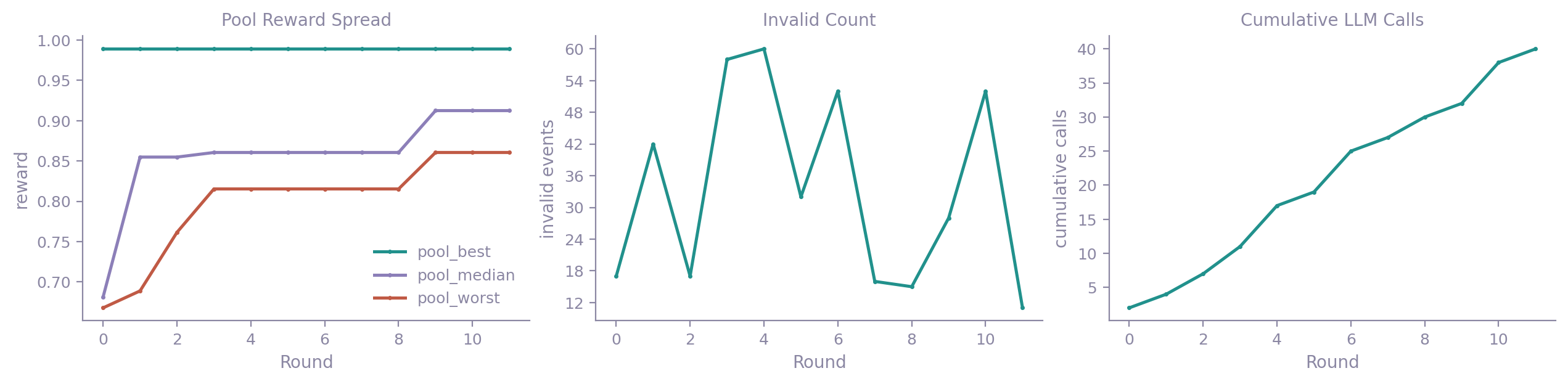
The per-round recorder includes pool_best, pool_median, pool_worst,
n_valid, n_invalid and n_llm_calls. The admitted count n_valid is
measured after truncation and saturates at samples_per_epoch. n_invalid
counts dropped scoring events, broken down into eight series:
n_invalid_undefined_operands, n_invalid_undefined_operators,
n_invalid_inexpressible, n_invalid_parse, n_invalid_non_finite,
n_invalid_lstsq, n_invalid_abnormal_coef and n_invalid_other.
They sum to the total in each round; unused causes record zero, and other
collects labels outside those named categories. Pool progress and admissions
help distinguish proposal failures from valid but poorly fitting equations.
Python setup
Endpoint configuration
Set an OpenAI-compatible base_url and OPENAI_API_KEY for the default
client; the OpenAI SDK is installed with KD. This is the algorithm that calls
an external language-model service during search. Alternatively, pass a
provider= implementing kd.llm.LLMProvider: a prompt goes in and text comes
out. A custom client can set timeouts and headers, use BudgetedProvider for
metering, or use TapeRecordingProvider to save a JSONL tape for offline replay.
The authors' mirrored datasets download on first load.
References
Du et al. (2024). "Large language models for automatic equation discovery of nonlinear dynamics". Phys. Fluids 36, 097121. Paper · arXiv:2405.07761
Code: menggedu/EDL
Implementation notes. KD ports the reference's finite-difference templates, STRidge tolerance sweep, coefficient gate, reward formula and rounding. The NumPy STRidge port matches its reference on identical design matrices. Prompt term permutation uses a plugin-owned seeded generator, including on resume. Columns use KD's executor instead of NumPy lambdify, so floating-point differences can affect candidates near the coefficient gate. Single-character candidates are scored rather than skipped. Constructs outside the prompt vocabulary, such as trigonometric functions and non-integer exponents, are rejected explicitly. The call budgets are KD additions. The paper used GPT-3.5-turbo; the KD client accepts OpenAI-compatible endpoints. The method's contribution is the prompting loop that generates equations and evaluates them by sparse regression.
Worked example
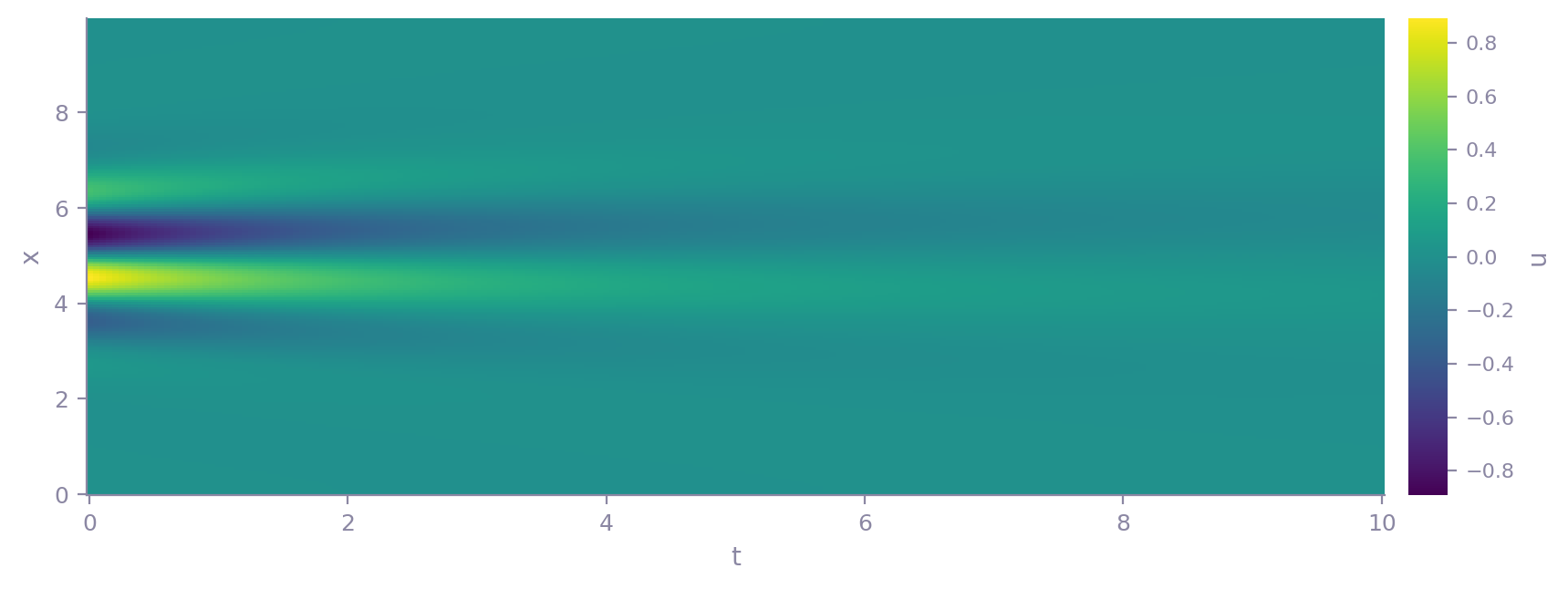
The run below uses the heat-equation dataset from the LLM4ED authors, mirrored
on Hugging Face Hub: a 200 × 201 grid over x in [0, 9.95] with periodic
boundaries and t in [0, 10]. The initial profile is a localized oscillation
centred near x = 5, a positive lobe at x = 4.55 against a negative one at
x = 5.45 with weaker lobes to either side, and diffusion spreads and flattens
it: the amplitude falls from 0.89 at t = 0 to 0.049 at t = 10, half of it gone
by t = 1.45.
The recorded requests and responses were replayed offline for twelve rounds.
The original endpoint served nvidia/llama-3.3-nemotron-super-49b-v1.5,
with a limit of six calls per round and seed 42. The equation returned
by the run:
| Equation | |
|---|---|
| Discovered | \(u_{t} = 0.05014 u_{xx}\) |
| Reference | \(u_t = 0.05\,u_{xx}\) |
The term and the coefficient match. The model wrote a two-term right-hand side,
u_xx + u u_x; the sparse regression fitted the second coefficient to zero, so
one term survives and the reward counts one term.
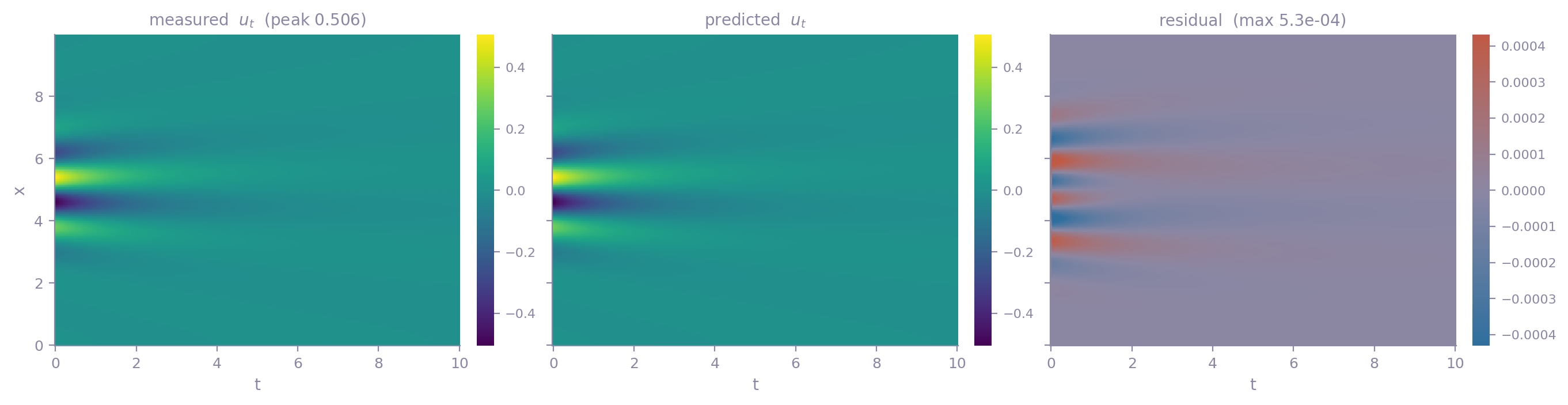
Example diagnostics
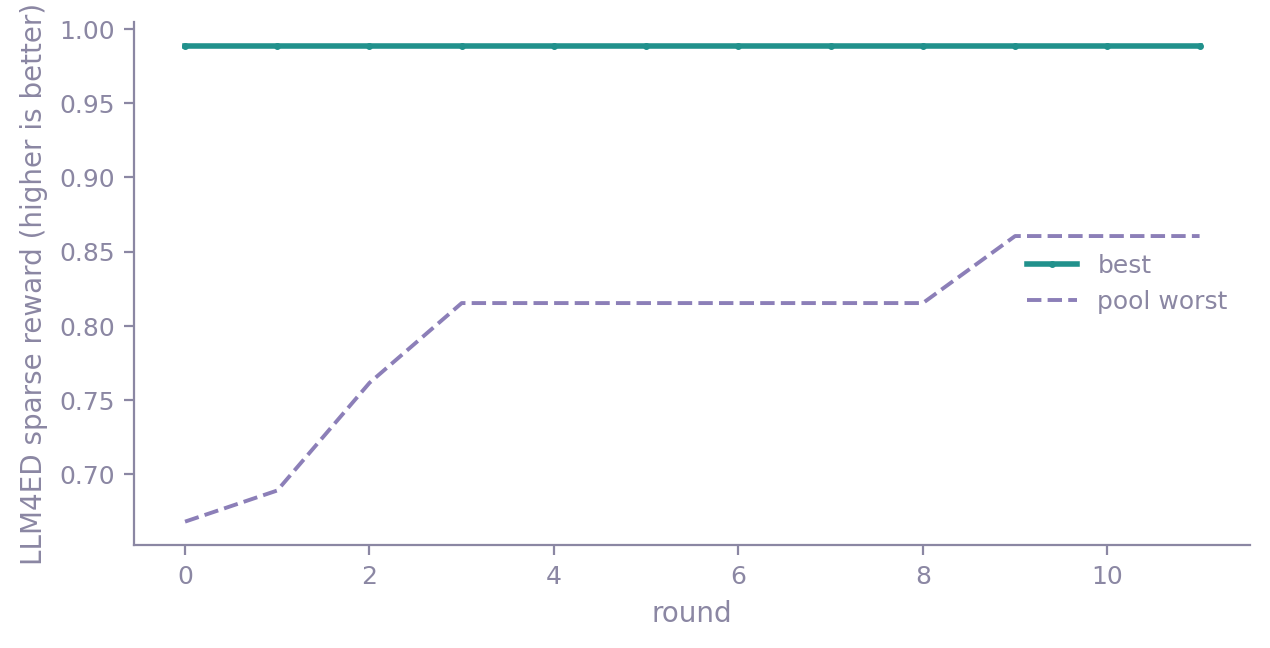
This run has LLM4ED sparse reward 0.9889 and NMSE 1.198e-06.
The search is recorded as well. kd.VizEngine renders the per-round record;
alongside the universal convergence curve, LLM4ED contributes three diagnostic
panels of its own (the full list is under Visualization):
viz = kd.VizEngine(output_dir="out/heat")
viz.render_all(model.result_, algorithm=model.algorithm_, dataset=dataset)
Full report
Full HTML report from the same run, with all figures, captions and raw result data.